Orinda property owners pushed back on two fronts at Monday, Aug. 17's Infrastructure Subcommittee meeting: one resident argues the city is overpaying for fire service by tens of millions of dollars, while private-road homeowners call a proposed maintenance options matrix "unfair" and demand the city take over all roads outright.
Public comments filed for the meeting also include a 106-signature petition demanding Zoom access to subcommittee sessions that has gone unaddressed since January.
Fire-tax fight: $21 million subsidy claim
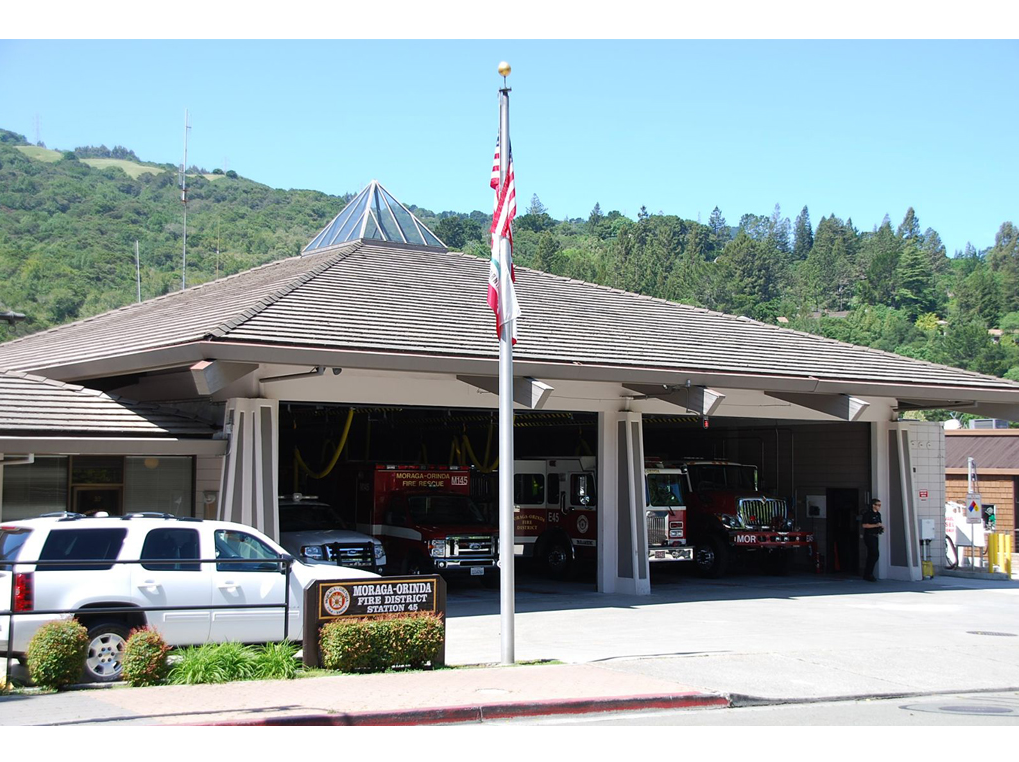
Resident Steve Cohn submitted a detailed financial analysis arguing that Orinda taxpayers are subsidizing Moraga's fire service through the Moraga-Orinda Fire District. His core claim: a Proposition 13 formula set in 1978, seven years before Orinda incorporated, sends 22.6% of all Orinda property taxes to MOFD. That compares to roughly 12% countywide, 19% in Moraga and 14% in Lafayette, according to public comments filed with the subcommittee.
Cohn calculates that MOFD's projected revenue over the next decade totals $500 million against $415 million in expenses, leaving $85 million in reserve buildup. Over that period, he argues, Orinda will contribute $106 million more than its allocated share while Moraga runs a $21 million deficit, effectively meaning Orinda subsidizes Moraga's operating costs.
"Maybe Orinda has to have its own fire department, which may be financially inefficient, but not as inefficient as 'giving away' a hundred million dollars over the next ten years," Cohn wrote.
He proposed three alternatives: pressure Orinda's MOFD board representatives to reallocate funds, recreate the Orinda Fire Protection District and contract with Contra Costa County Fire, or partner with Lafayette, which Cohn said has the same three stations and nine firefighters but pays $6 million less per year.
Cohn's figures are his own calculations based on MOFD's long-range financial plan and have not been independently verified. MOFD and city officials were not reached for comment.
Private roads: 'Grossly overpriced' options
About 20% to 22% of Orinda residents live on private roads the city does not maintain. The subcommittee's options matrix drew sharp criticism.
Joel Libove wrote that all options except outright road acceptance appear "insultingly useless and grossly overpriced" to private-road residents who pay the same taxes as neighbors on public streets. The one option he called workable would accept only one street per year. Too slow, he said. All at-risk private roads should be accommodated within three years.
The matrix charges private-road owners $2,000 each to have their street accepted. Libove argued that private roads carrying storm water need public status to qualify for FEMA disaster reimbursement, noting the city received nearly $4 million from FEMA for public road repairs during a recent declared disaster.
Scott Richland and his wife Cathleen, of Oak Arbor Road, called all proposed solutions "unfair at best and completely infeasible at worst." Oak Arbor was rated the second-worst road in condition citywide, and 20 homes depend on it for access. The Richlands said no document in their 2021 purchase disclosed the road was private. They pay roughly $51,000 per year in property taxes. None of that, Richland argued, goes to maintaining the road in front of their home.
At the March 3 Orinda City Council meeting, Council Member Darlene Gee said the city draws on multiple revenue sources for road maintenance, including road bonds, state grants, sales tax and Measure R, as reported by the Lamorinda Weekly.
106 residents want Zoom access
Cohn reported delivering a petition to Council Members Gee and Latika Malkani on Jan. 31 requesting Zoom access and archived recordings of subcommittee meetings. The petition has grown to 106 signatures. It was not placed on the March 16, June 22 or Aug. 17 agendas.
The meeting was held Monday at 22 Orinda Way. Outcomes were not yet available at publication time. The next subcommittee meeting date has not been confirmed by the city.