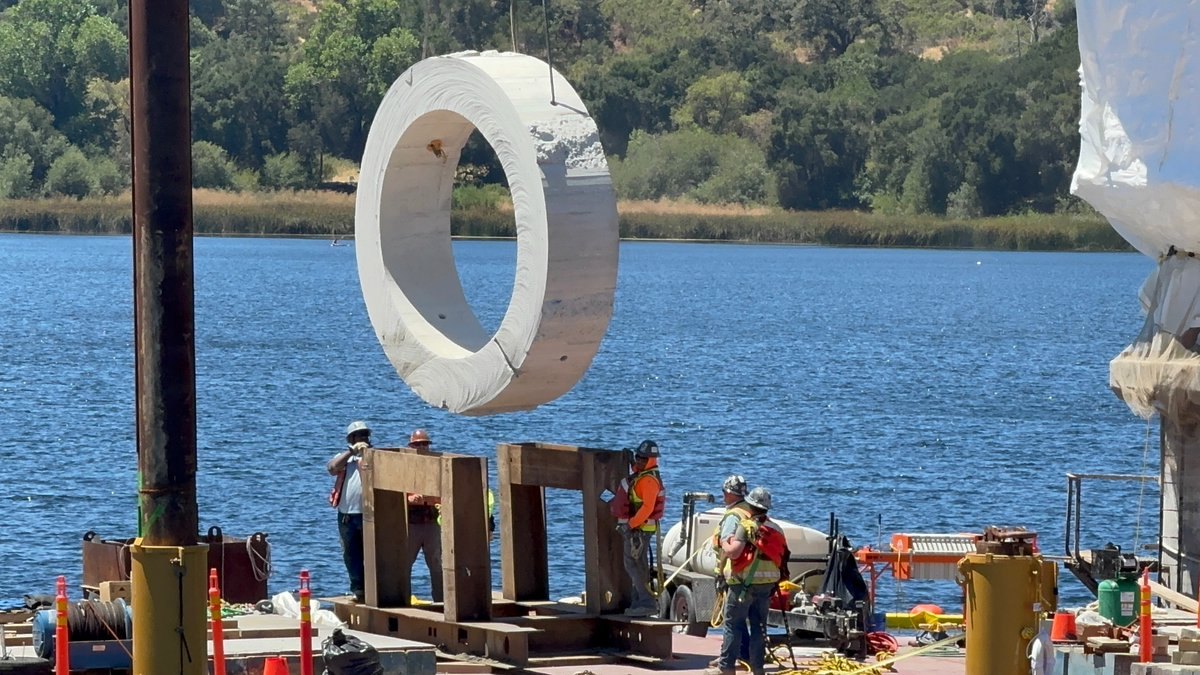
The nearly century-old tower rising from Lafayette Reservoir is getting shorter. Crews are removing 40 feet from the top of the landmark structure, ring by ring, using a crane mounted on a floating barge as part of a $14 million seismic upgrade that EBMUD expects to finish by the end of October.
The East Bay Municipal Utility District posted photos of the work in progress on Thursday, Aug. 6. Construction began in early July.
The tower serves as the reservoir's only spillway and outlet, regulating water levels and connecting to the dam's sole drain system. Seismic studies found the structure could bend and break during a major earthquake, potentially damaging conduits at its base and preventing operators from safely releasing water. That scenario could lead to uncontrolled flooding in Lafayette, Walnut Creek and downstream communities.
"The higher, the taller it is, with age and deterioration, there's more risk that it could crack or break," EBMUD spokesperson Christopher Tritto told CBS News San Francisco on July 10, when dismantling began.
The California Division of Safety of Dams categorizes the flood risk downstream of Lafayette Reservoir as "extremely high." The reservoir received a "Fair" safety rating from DSOD because of the tower's structural vulnerabilities. All other EBMUD dams received "Satisfactory" ratings. State flood maps show a potential dam failure could inundate portions of Lafayette and Walnut Creek, including at least one K-8 school, the Lafayette Police Department and the Lafayette BART station.
Why 40 feet?
The tower was built taller than needed because plans changed mid-construction. EBMUD originally intended the dam to stand 33 feet higher, which would have created a reservoir nearly three times larger. But the soil couldn't support that height, and the embankment began to move. By the time engineers lowered the dam, the tower had already been built for the larger design, according to EBMUD's project page.
The Moraga Fault runs directly under the reservoir. It last produced a major earthquake in 1956, registering magnitude 5.2. The fault is part of the Hayward Fault System, capable of a magnitude 7.25 earthquake.
Years of community pushback
The project drew years of community opposition. The Lafayette City Council met with EBMUD at least seven times since 2015 to discuss the tower's future, according to the city's project page. A Citizens Advisory Committee of Lafayette residents with engineering expertise argued the tower could be retrofitted at its current height.
EBMUD delayed the project more than a year and spent over $500,000 reevaluating those alternative concepts before proceeding with the shortening plan. In November 2024, DSOD sent a letter to the city reaffirming that the shortening design was safe and appropriate, stating that the city's proposed retrofit concepts likely would not meet required safety standards.
What the finished tower will look like
According to EBMUD's project page, the top of the shortened tower will feature a metal operating house that closely resembles the original design. The district preserved elements of the original structure, including a historic window dating to the late 1920s. The reservoir does not need to be drained during construction, and the recreation trail remains open.
Residents with questions can contact EBMUD Community Affairs at [email protected] or 510-287-2053. The project is expected to wrap up by the end of October.